Join Our Blog

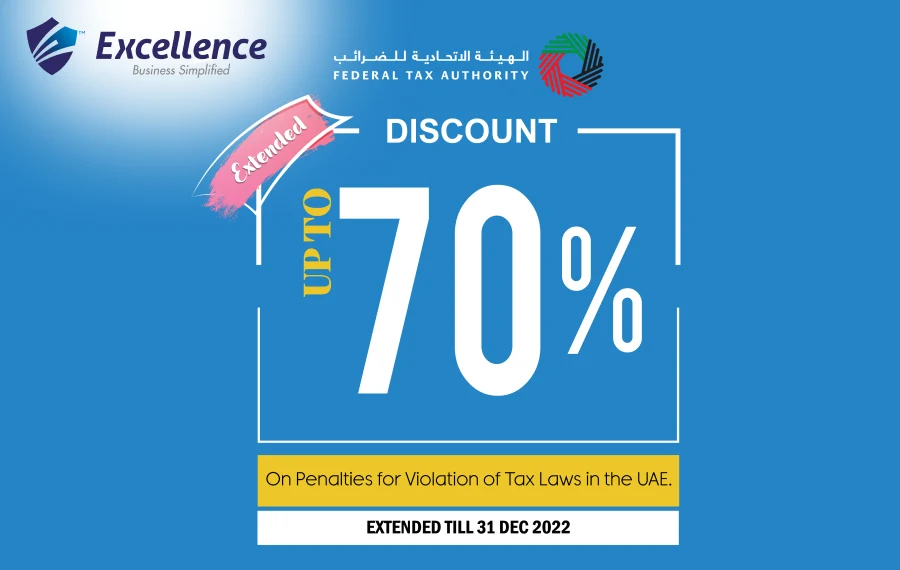
DISCOUNT UP TO 70% ON PENALTIES FOR TAX LAWS

  February 16, 2025

UAE: AMENDMENT OF ADMINISTRATIVE PENALTIES IMPOSED FOR VIOLATION OF TAX LAWS AND REDUCTION OF PREVIOUSLY IMPOSED PENALTIES

IN BRIEF

On 28 April 2021, the UAE Cabinet of Ministers issued Resolution No. 49/2021 to amend the provisions of Cabinet Resolution No. 40/2017 relating to administrative penalties imposed for violation of Tax Laws in the UAE.

Federal Tax Authority (FTA) has called upon tax registrant on Monday, 24th January 2022 to benefit from Cabinet Decision No 49 of 2021, to extend the grace period for re-determination of administrative penalties on violating tax laws until 31/12/2022.

EFFECTIVE DATE OF THE NEW CABINET RESOLUTION

The new resolution shall be effective after sixty (60) days from the date of its issuance on 28 April 2021, i.e. effective as from 28 June 2021.

IN DETAIL

Cabinet Decision no. 49/2021 replaced Cabinet Decision no. 40/2017 relating to administrative penalties imposed for the violation of Tax Laws in the UAE.

Amendment of administrative penalties

The new resolution amends the administrative penalties listed in Table No. (1), Table No.(2) and Table No. (3) of Cabinet Decision No. 40/2017.

Some of the key amendments to the administrative penalties listed in the new resolution are as follows (non-exhaustive list):

AED 20,000 reduced to AED 10,000 for failure of the taxable person to submit a Registration Application within the timeframe specified in the Tax Law.

•    AED 10,000 reduced to AED 1,000 monthly (not exceeding AED 10,000) for failure of the registrant to submit a Deregistration application within the timeframe specified in the Tax Law.

•   AED 15,000 reduced to AED 5,000 for failure by the taxable person to display prices inclusive of VAT.

•   AED 5,000 (for each tax invoice) reduced to AED 2,500 (for each instance discovered) for failure by the taxable person to issue a tax invoice/tax credit note or an alternative document when making any supply.

•   AED 5,000 (for each tax invoice) reduced to AED 2,500 (for each instance discovered) for failure by the taxable person to comply with the conditions and procedures regarding the issuance of electronic tax invoices and electronic tax credit notes.

•   Moreover, the percentage based penalties applicable to the late payment of the tax due – in the tax return or in the voluntary disclosure or in the tax assessment – are reduced and the 1% daily penalty previously imposed is eliminated. 

•   The new late payment penalty is now calculated as follows (the 300% cap still applies):

•   2% of the unpaid tax due on the day following the payment due date, 

•   4% monthly penalty due after one (1) month from the payment due date, and on the same date every month thereafter, on the amount of tax that has not been paid to date.

•   The voluntary disclosure penalties that are applicable to the difference between the tax declared and the tax due are now linked to the period during which the taxpayers amend the previously submitted VAT returns and range between 5% (in case the voluntary disclosure was submitted within 1 year from the due date of tax return or tax assessment or refund application) and 40% (in case the voluntary disclosure was submitted after the 4th year). 

•   Please refer to the Cabinet Resolution No.49/2021 for a comprehensive list of the amended administrative penalties for violations of tax laws in the UAE.

Discounts for previously imposed penalties

Administrative penalties – that have not been paid – imposed before the effective date of the new resolution will be reduced to 30% of total unpaid penalties if all of the following conditions are met:

1. The penalty must have been imposed and due before June 28, 2021 

2. Settle all due payable tax by December 31, 2022.

3. Settle 30% of the total unsettled administrative penalties imposed before June 28, 2021 no later than December 31, 2022.

THE TAKEWAY

If these conditions are met, the administrative penalties shall be redetermined after 2022 and registrant won’t be required to pay the remaining 70% of the unpaid administrative penalties.

In a digital-first economic landscape, countries with a first-mover advantage are rapidly becoming global innovation hubs. The UAE’s implementation for mandatory e-invoicing is one of the steps in that direction. In a bid to help businesses prepare better, the Federal Tax Authority recently announced the extension to the deadline for appointing an Accredited Service Provider (ASP) from 1st July to 30th October, 2026. This extension will enable businesses that are still assessing the regulatory requirements to lay the

necessary groundwork before implementing the system in their operations, while ensuring all compliance obligations are met. While offering flexibility, this also presents an opportunity for owners to closely monitor the systems and controls before the mandatory rollout comes into effect. E-invoicing is steadily reshaping how enterprises operate in the UAE, moving invoicing beyond PDFs, scans, and email-based exchanges.

Under the new framework, invoices will now be generated in XML format, enabling standardised data exchange and direct reporting to the FTA.

The new framework will do more than just improve efficiency and transparency with a seamless exchange of invoicing data, but etch a new chapter in how compliance will look in a digital tax ecosystem.

In a digital-first economic landscape, countries with a first-mover advantage are rapidly becoming global innovation hubs. The UAE’s implementation for mandatory e-invoicing is one of the steps in that direction. In a bid to help businesses prepare better, the Federal Tax Authority recently announced the extension to the deadline for appointing an Accredited Service Provider (ASP) from 1st July to 30th October, 2026. This extension will enable businesses that are still assessing the regulatory requirements to lay the necessary groundwork before implementing the system in their operations, while ensuring all compliance obligations are met. While offering flexibility, this also presents an opportunity for owners to closely monitor the systems and controls before the mandatory rollout comes into effect. E-invoicing is steadily reshaping how enterprises operate in the UAE, moving invoicing beyond PDFs, scans, and email-based exchanges.

Under the new framework, invoices will now be generated in XML format, enabling standardised data exchange and direct reporting to the FTA.

The new framework will do more than just improve efficiency and transparency with a seamless exchange of invoicing data, but etch a new chapter in how compliance will look in a digital tax ecosystem.

E-Invoicing in the UAE

Why This Extension Matters

With the mandatory rollout to come into force from January 2027, the extension does not alter the UAE’s broader e-invoicing timeline. The initial rollout will see businesses generating annual revenues above AED 50 million, leading the transition with smaller enterprises gradually brought in through subsequent phases.

This preparation window showcases the consideration and planning that is required ahead of the rollout. As the system pivots towards e-invoicing, it becomes more than just the exchange of data. It comes down to how businesses manage the data, the reporting process in place, and if they are in sync with the compliance requirements.

Enterprises in Dubai and other emirates are turning their attention towards the quality of the invoice data while ensuring consistency and the ability of the existing systems to support machine-readable invoices.

Another key challenge for organisations that are operating across multiple entities or invoicing platforms will be integration and standardisation. This is where having the right ASP matters. With the implementation timeline moving closer, the demand for the ASP is anticipated to see an increase.

The revised deadline will help businesses get more time to make early planning and conduct accurate evaluation.

Accredited Service Providers

A Key Component of the E-Invoicing Framework

The announcement brings the role of the accredited service providers within the UAE’s e-invoicing ecosystem into the spotlight. With businesses transitioning to incorporate accounting and ERP systems into their operations to generate invoices, the ASP will become the linchpin between them and the regulatory authorities.

ASPs will now not only have to facilitate the exchange of the data but also ensure a standardised structure for invoicing across the UAE’s e-invoicing ecosystem. The support by the ASP will enable ease in compliance and meeting the technical requirements.

The extension also gives significant time for businesses to assess and align an ASP that meets their operational requirements. While for many organisations, this also presents an opportunity to take a closer look at their integrations and carefully understand the ability of the provider to support their existing accounting and ERP systems.

UAE E-Invoicing Penalties

Why Early Preparation Matters

The extension provides additional time for businesses to implement the necessary requirements. But for companies that are still on the fence, this becomes a final call as failure to comply with the requirements and the UAE’s e-invoicing framework may result in financial penalties, including AED 5,000 per month for implementation delays and AED 100 per invoice for non-transmission.

Excise Tax Work in Dubai

Final Words

The announcement of the extension reflects the UAE’s level-headed approach and pragmatism in establishing the e-invoicing framework as a stepping stone in its broader tax strategy. With countries like Saudi Arabia and India reaping the benefits of their respective e-invoicing systems, the UAE’s phased approach ensures that businesses are equipped with the right tools to ensure a streamlined transition.

The shift towards e-invoicing is a nod to the future, where the tax landscape will see the information travel faster and compliance becoming embedded in critical operations. The new framework is expected to see businesses generate standardised invoices that will drive the new reporting ecosystem forward.

-->

Simplify Your Business with A Touch of Excellence

Mobile Whatsapp